
Project context
A Website Case Study - CodingBeings
Industry: Custom apparel and promotional printing | Role: WordPress Developer | Stack: WordPress, WooCommerce, PHP, InkSoft, JavaScript, jQuery
The Idea
Peanut Butter Printing needed more than a standard merchandise store. Customers and company branches had to create personalized apparel, order production-ready quantities and benefit from lower pricing as collective demand increased. The goal was to connect design, purchasing and campaign-based volume pricing in one understandable journey.
What I Built
I built a WooCommerce experience that connected InkSoft's embedded Design Studio to direct ordering, enforced a 20-item minimum and applied custom pricing tiers based on cumulative purchases. Campaign controls and branch-specific checkout fields completed the workflow from customization to procurement.
From a blank shirt to the cart in one guided flow
Customers could launch InkSoft, add and format text or artwork, position the design on a shirt and preview the result before ordering. The completed customization flowed into the WooCommerce purchasing journey, removing the need to exchange design instructions manually before checkout.
Group purchasing that rewarded collective demand
A custom WooCommerce plugin gave administrators six quantity-and-price thresholds. The platform counted completed purchases across individual and grouped products, displayed the active price and recalculated cart pricing as cumulative sales crossed each configured milestone.
Campaign controls made time-bound ordering manageable
Each product campaign could have an expiry date. Product pages showed the remaining days, purchase progress, upcoming pricing thresholds and the quantity still needed. When a campaign expired, ordering was disabled and customers were directed to contact the business about reopening it.
Checkout adapted to branch procurement
The checkout replaced the generic company field with a four-digit Cost Center Code, renamed the address field as Branch Address and removed unnecessary phone and shipping inputs. This kept the final step aligned with internal branch ordering rather than a generic consumer checkout.
Platform Architecture
InkSoft provided the interactive design canvas, while WordPress and WooCommerce managed products, grouped purchasing, campaign rules, cart pricing and checkout. Custom PHP connected cumulative sales to six pricing tiers and custom templates made progress and expiry status visible to buyers.
Custom design and group-ordering architecture
Operational flow
- Configure products, expiry and price tiers
- Create artwork in InkSoft
- Validate quantity and apply active tier
- Completed orders update campaign progress
View original diagram at full resolution
Scroll within the figure to inspect its original labels and connections.
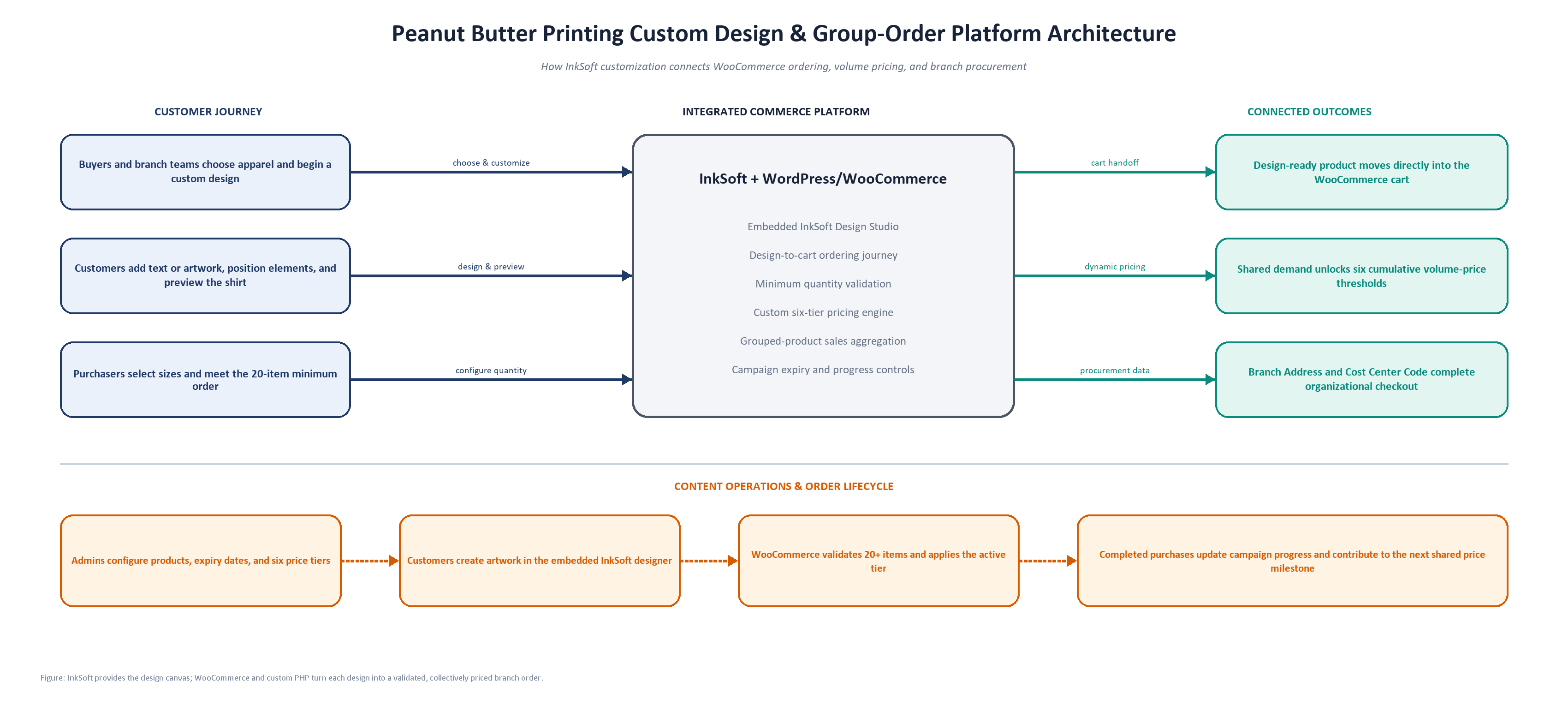
Figure 1 - InkSoft customization flows into WooCommerce ordering, campaign controls, volume pricing and branch procurement.
Technical Highlights
Embedded InkSoft Design Studio so customers could create and preview personalized shirts before ordering.
Connected completed designs to WooCommerce cart and checkout, with a minimum order quantity of 20 items.
Developed a custom plugin supporting six cumulative quantity thresholds and six corresponding price levels.
Calculated pricing across simple and grouped products using WooCommerce sales data and updated cart prices before totals were finalized.
Added responsive purchase-progress visuals, product expiry handling, remaining-days messaging and branch-focused checkout fields.
Where the Project Landed
The finished platform combined self-service design with a structured group-ordering model. Customers could move from an idea to a previewed shirt and then into a validated WooCommerce order, while participating branches could collectively unlock better pricing. The available archive contains the WordPress commerce layer while InkSoft is externally hosted, so the result is presented without unverified conversion or revenue figures.
Takeaways
This project demonstrates how a third-party design tool can become part of a purpose-built ecommerce workflow rather than remain a separate utility. Its strongest achievement was connecting creative customization, production minimums, cumulative pricing, campaign deadlines and organizational checkout into one coherent ordering experience.