
Project context
A Website Case Study - CodingBeings
Industry: Luxury jewelry retail | Role: Lead WordPress Developer | Stack: WordPress, WooCommerce, PHP, MySQL, Stripe, PayPal
The Idea
A US luxury-jewelry retailer sold limited-edition diamonds and one-of-a-kind pieces through a national website and multiple regional storefronts. The same physical item could appear on several sites, so the business needed one dependable way to prevent two customers from buying it at the same time.
What I Built
As Lead WordPress Developer within the delivery company, I advised the client on the transaction flow and built a cross-store reservation system around three states - Available, Reserved and Sold - using SKU identity, WooCommerce hooks and controlled database connections.
One shared inventory identity across independent storefronts
Each storefront remained a separate WordPress and WooCommerce installation, but the same physical article used a consistent SKU everywhere. A custom database helper used that SKU to locate and update the matching product across the network without requiring customers or administrators to manage inventory manually on every site.
A five-minute reservation protected every checkout
When a customer added a unique item to the cart, the helper immediately reserved its SKU across every storefront. Other shoppers could still browse, but could not add or purchase that article. A five-minute checkout timer made the exclusivity visible while preventing abandoned carts from blocking inventory indefinitely.
Payment events finalized or released inventory everywhere
Stripe and PayPal events determined the final state. Successful payment marked the SKU sold out across all sites immediately. A failed payment, removed cart or expired timer released the reservation and restored availability everywhere. Email alerts kept the operations team informed of inventory and sale activity.
Client guidance was part of the architecture
The hardest part was not a single WooCommerce function; it was defining a fair transaction policy for simultaneous demand. I worked with the client to translate that business question into clear reservation, timeout, payment-success and payment-failure rules, then implemented those rules through WordPress actions and filters.
Platform Architecture
WooCommerce handled each storefront's cart and order experience, while the custom helper coordinated SKU state across the distributed databases. Reservation and payment events became the control points that kept every storefront synchronized.
Distributed inventory reservation architecture
Operational flow
- Customer adds item to cart
- Reserve SKU across all stores for five minutes
- Checkout with Stripe or PayPal
- Success: sold everywhere; timeout or failure: released everywhere
View original diagram at full resolution
Scroll within the figure to inspect its original labels and connections.
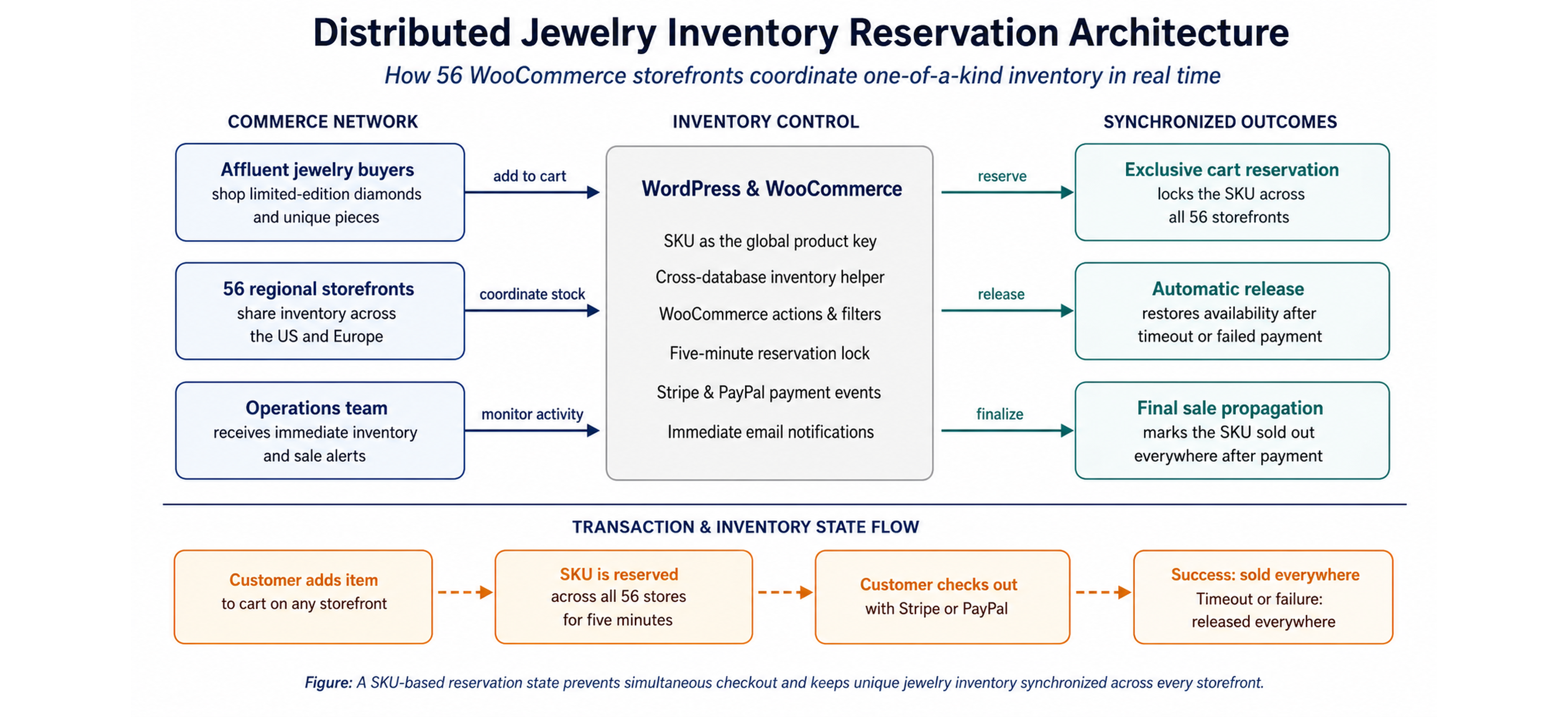
Figure 1 - A five-minute SKU reservation prevents simultaneous checkout and synchronizes final inventory across 56 storefronts.
Technical Highlights
Designed a distributed Available-Reserved-Sold inventory workflow for one-of-a-kind diamonds and limited-edition jewelry.
Used SKU as the global product key across independent WordPress and WooCommerce databases.
Connected add-to-cart, cart expiration and order-status events through core WordPress and WooCommerce actions and filters.
Integrated Stripe and PayPal payment outcomes with immediate sold-out or inventory-release propagation across the network.
Added five-minute customer countdowns and operational email alerts to make reservation status visible and actionable.
Where the Project Landed
The reservation model eliminated the duplicate-sale issue and became a successful operational foundation for the retailer. The network ultimately grew to 56 synchronized storefronts as the business expanded beyond the United States into Europe. The client was highly satisfied, and my employer recognized the contribution with a performance bonus and Employee of the Month award.
Takeaways
Scarce inventory changes the meaning of an online cart. For unique products, adding an item must create a temporary network-wide promise, not merely a browser session. By turning that promise into an explicit timed state, the platform protected customers, prevented overselling and supported international growth without centralizing every storefront into one installation.